Showing posts with label Bruce Nauman. Show all posts

06 September, 2011

6 Sept - Packing for Mars


I just finished Packing for Mars, by Mary Roach. Admittedly, this book does not discuss, tangentially or otherwise, anything related to art. But it is so entertaining, so fascinating, that I can't resist mentioning it in the blog. And I hear Bruce Nauman also loved it. So there you go.

In Packing for Mars, Roach explores and details the types of stories that NASA would most likely prefer to remain under wraps. This book is about the embarrassing, awkward, mundane, and utterly human aspect of space research and travel. The Publishers Weekly review describes that “despite all the high-tech science that has resulted in space shuttles and moonwalks, the most crippling hurdles of cosmic travel are our most primordial human qualities: eating, going to the bathroom, having sex and bathing, and not dying in reentry. Readers learn that throwing up in a space helmet could be life-threatening, that Japanese astronaut candidates must fold a thousand origami paper cranes to test perseverance and attention to detail, and that cadavers are gaining popularity over crash dummies when studying landings.”

One of the best aspects of Roach's research is that she throws herself into the project - she experiences parabolic flights in the "vomit comet", practices on zero gravity toilets, and drinks her own treated urine in the NASA cafeteria. She is unquestionably t
he type of adventurous friend who would lead you to delicious, scandalous, memory-making trouble. She can even make Jon Stewart
blush.

This book is a work of art. It is the dark and dirty and juicy details of rocket science. Roach is brilliant, unfailingly inquisitive, and laugh out loud funny. If my college physics professor had been this interesting I could be working at NASA by now. Well, maybe not.

23 May, 2011

23 May - Prada & Risk


If I were to attempt to follow my thread of musings in the art world and how they manifest in the form of this blog, the common denominator may be my belief in the manifest value of taking risks. Through the works and minds of such disparate characters as Olaffur Eliasson, Marcia Tucker, Alanna Heiss, Bruce Nauman, Dave Hickey, Robert Irwin, Lady Gaga, and Banksy (to name but a few), I have explored the ways that taking risks -- and being uncertain of their outcome -- incites dialog, innovation, fury, passion, transformation.

In the June issue of Vanity Fair, Ingrid Sischy (former Editor and Chief of Interview Magazine) reports on Miuccia Prada and Patrizio Bertelli's approach to fashion, life, and the creation of the remarkable art collection that will be presented publicly for the first time in conjunction with the Venice Biennale next month. The Prada Foundation's new home is a 65,000 square foot 18th-century plaza on the Grand Canale in Venice. Sischy describes Prada and Bertelli as collectors dedicated to risk and outside-the-box ideas in the arts, supporting extraordinarily ambitious projects, massive in scale and frequently volatile in nature. "When it comes to materials and logistics, says Prada, 'we are attracted to the nightmares.'"

Prada and Bertelli are remarkable for their approach to collecting. They are unique voices amidst the predictable and often clichéd accumulations of high profile art collectors. Not interested in the checklist of heavy auction hitters and the art stars of the moment, "Prada and Berletti have become legendary in the fashion and art world for making their own rules. But they are also believers in careful study; thus, when they decided in the early 1990's to focus on modern and contemporary art as collectors, and to create a foundation that would support outside-the-box ideas, theirs was a commitment."

Contemporary art can create space for independent thought beyond conventional structures and tacit social boundaries. It can electrify minds and create new conduits to experience life, with its issues and conflicts. Prada and Berletti are clearly active and engaged participants in an important international art dialog that involves innovation, originality, and risk. Describing the inaugural exhibition to be presented next month, Sischy asserts that "new ideas don't come along that often, but the exhibition provides a kind of petri-dish environment in which they can cook. Or think of it as a jam session, with artworks riffing on one another thanks to evocative or provocative juxtapositions - Prada likes surprising couplings and unexpected combinations in her fashion as well as her art."

Promoting the possibilities of art, what Tate Director Nicholas Serrota describes as "the nerve endings of contemporary art," requires an openness and excitement in the face of uncertainty rather than the assurance of subscribing to the costly and commercial status quo. Art critic and curator Dave Hickey stated that “if you don’t take risks, if you confirm the prescience of previous investors, you acquire no power, create no constituencies, and have no effect. So you must take risks."

In the Vanity Fair interview Prada states it is "better to make mistakes than be totally correct. We want to do something alive… The whole idea was to try and do something that could help produce new ideas in the future. However much we criticize art for being commercial, it is still a place for freedom and thinking and creativity."

Images: Photographs of the Prada Foundation by Sam Taylor-Wood for Vanity Fair, portrait of Prada by Guido Harari

17 April, 2011

17 April - Modigliani: A Life


LAUNCHPROJECTS - I just finished the new Meryle Secrest biography Modigliani: A Life. Known for his Francis Bacon-esque life of hard drinking, drugging, and womanizing; this biography sheds new light on Modigliani's life-long battle with Tuberculosis. Secrest's biography is in many ways an argument that Modigliani's drinking and drug use was predominantly “a cover (or a compensation) for the debilitating tuberculosis that he kept secret –- a spasmodic condition managed with the opium, laudanum and alcohol that contributed mightily to his tragic death at 35.”

The epidemic of Tuberculosis in Europe from 1800 - mid 1900's was a terrifying and deadly situation - one that could be likened to the AIDS epidemic of contemporary society. A contagious disease without a cure at the time, "consumptives" were frequently shunned and ostracized from society. Secrest's hypothesis is that Modigliani would have gone to any extreme to hide his condition. Immoderation, however, was also a part of the artistic lifestyle - fuel to the creative force - and the majority of artists, writers, dancers, and actors living in Paris in the early to mid 1900's lived in the extreme.

Among Modigliani's great and influential peers at the time included Pablo Picasso, Georges Braque, Constantin Brancusi and Chaim Soutine. Each felt destined for a special fate in life, one that released them from the conventional mores and standards of their time. As Secrest describes, “like Frank Lloyd Wright a few years later, Modigliani was clearly influenced by Nietzsche’s theories about the emergence of the Übermensch.The artist, as Superman, was divinely endowed, therefore divinely inspired, for as Nietzsche also wrote, the artist had his own truth, or a special kind of truth. ‘He fights for the higher dignity and significance of man; in truth, he does not want to give the most effective presumptions of his art: the fantastic, uncertain, extreme, the sense for the symbolic… the faith in some miraculous element in the genius.’” In a letter to a friend Modigliani wrote that “People like us… have different rights, different values than do the normal, ordinary people because we have different needs which puts us – it has to be said and you must believe it – above their moral standards.”

Modigliani and peers believed they were different, chosen, fated. “In his mind, fatalism and idealism, creativity and death, seemed intertwined.” The conviction that the true artist is one destined to live a tortured and extreme life beyond the bounds and rules of conventional society remains to this day. One of Bruce Nauman’s iconic works of art is a neon installation that reads “The True Artist Helps the World by Revealing Mystic Truths.” Nauman, in describing this piece that proclaims the artist as outlier and oracle, stated that “the most difficult thing about the whole piece for me was the statement. It 
was a kind of test—like when you say something out loud to see if you believe it. Once written down, I could see that the statement [...] was on 
the one hand a totally silly idea and yet, on the other hand, I believed it. 
It's true and not true at the same time. It depends on how you interpret it 
and how seriously you take yourself. For me it's still a very strong thought.” Just add tragedy and stir.

30 January, 2011

30 Jan - In Memory of Dennis Oppenheim


LAUNCHPROJECTS- Dennis Oppenheim, Conceptual artists, pioneer of earthworks and body art who made "made emphatically tangible installations and public sculptures that veered between the demonically chaotic and the cheerfully Pop," died on Friday in Manhattan of liver cancer. He was 72.*


We met him just once at Alanna Heiss' home at a dinner for James Franco after an opening at Heiss' latest venture since P.S.1, Art on Air. Oppenheim was clowning around in Heiss' bedroom in front of one of his works of art. He was charming and silly - almost giddy - and befriended us immediately upon learning of our mutual friend in Santa Fe, Thomas Ashcraft. Sitting in the room with such an iconic and fascinating artist who challenged so many notions and definitions of art throughout the decades I had to keep reminding myself that this accessible prankster was THE Dennis Oppenheim. His work can be tough to pin down and describe, so I will use the words of Roberta Smith for the New York Times:

"Many works involved moving parts, casts of animals (whole or partial), upturned or tilted building silhouettes and sound, water and fireworks, which on occasion prompted unscheduled visits by the fire department....He first became known for works in which, like an environmentally inclined Marcel Duchamp, using engineers' stakes and photographs, he simply designated parts of the urban landscape as artworks. Then, in step with artists like Robert Smithson, Walter De Maria and Lawrence Weiner, he began making temporary outdoor sculptures, soon to be known as land art or earthworks.

...Mr. Oppenheim's art-making could seem simultaneously driven and lackadaisical, fearless and opportunistic. Few of his contemporaries worked in a broader range of mediums or methods, or seemed to borrow so much from so many other artists. His career might almost be defined as a series of sidelong glances at the doings of artists like Vito Acconci, Mr. Smithson, Bruce Nauman, Alice Aycock (to whom he was married in the early 1980s) and Claes Oldenburg."

Oppenheim stands out for his impact and wholly original - often inconceivably rigorous - works of art in an era of artists who continually challenged the definitions and status quo of the traditional art world. He was one of the greats.


IMAGES: Oppenheim, "Device to Root Out Evil in Canada" 1991, Oppenheim at Heiss house (in front of his piece), 2010.
*Quote also from Roberta Smith, New York Times

13 January, 2011

13 January - Sweet Marina Abramovic


LAUNCHPROJECTS -
Park Avenue Winter,
one of the New York Times, New York Magazine and New York Observer's best new restaurants in New York City,
is collaborating with the non-profit Creative Time to team up with artists including Marina Abramovic, Janine Antoni, Paul Ramirez Jonas, and Michael Rakowitz to create seasonal dishes over the next few months.

Abramovic is first, collaborating with chef Kevin Lasko on a $20 dessert called the Volcano Flambe. As described by Florence Fabricant in the New York Times "Its core of dark chocolate ice cream is covered with meringue, decorated with gold leaf and a swirl of spun sugar, bedded on chocolate cookie crumbs and flambéed with rum. The artist's booklet of off-beat recipes, 'Spirit Cooking,' and an MP3 player with a talk by her accompany the dessert." I eagerly await Antoni's dish, though I can't seem get the image of her 2008 piece "Eureka" out of my mind when imagining her in the kitchen... (image above).

Santa Fe is an ideal place for such innovation and collaboration. I picture Patrick McFarlin whipping up Thiebaud-esque confections at Coyote Cafe and Clayton Porter plating wild board dishes at the Compound. How about convincing the likes of Larry Bell, Ken Price, Sherrie Levine, Susan Rothenberg, and Richard Tuttle to participate? Brian Knox and Bruce Nauman could surely cook up something spectacular and bizarre at Aqua Santa. I would eat out every night just to see what artists dream up with the inspired chefs in our community. Even better if a local non-profit benefits.

Creative Time's mission statement asserts that they are "thrilled when art breaks into the public realm in surprising ways... We like to make the impossible possible, pushing artists beyond their comfort levels, just as they push us beyond ours. In the process, artists engage in a dynamic conversation between site, audience, and context, offering up new ideas about who an artist is and what art can be, pushing culture into fresh new directions." This collaboration is precisely an enactment of that mission and I would love to see a non-profit in Santa Fe activate our community beyond the visual arts in a similar fashion. SITE's SPREAD is certainly a start - but I encourage our community to keep pushing the boundaries of how art can function in all of our daily lives.

16 November, 2010

16 November - Bruce Nauman at Sperone Westwater


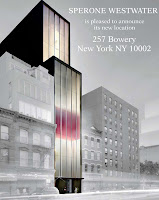
LAUNCHPROJECTS - While in New York we attended a private reception at Sperone Westwater for the latest Bruce Nauman exhibition For Children/For Beginners. The brand new Bowery space is a 25 by 100 footprint that includes 12 by 20 foot “moving gallery” - a very large elevator - approved as an "amusement ride" by the city of New York. The space is chic and a bit daunting to behold and the clean white interior worked well for Nauman’s site-specific audio and video installations.
Nauman’s installations enveloped the gallery, a projection of his hands filled the massive front wall with his voice calling out commands for his fingers to follow. I loved that it was his voice this time that commanded the room and his movements. The moving gallery was comprised three precarious (yet surprisingly comfortable) stools with only an elevator operator and the sounds of Terry Allen following Nauman’s instructions to play on the piano. The dynamic cacophony moved us slowly to the third floor where a clean white room held an audio installation of voices repeating over and over For the Children.
Nauman’s work perpetually poses challenges, creates tension, and heightens awareness through disorientation, frustration, awe, confusion, anger, and humor. The new Sperone Westwater exhibition space engages audiences in a similar manner. We found ourselves uncomfortably laughing at the opening as we heard voices and saw glimpses of people moving throughout the space, yet bodies and voices disappeared as we arrived to each floor to meet them. The gallery unquestionably boasts a white-cube Nauman/Hitchcockian mystique yet inherent in its design is a sense of isolation and frustration – even the staff has to have a surveillance camera base operator to find one-another throughout the day.
Fitting that the space dedicated to Nauman’s ongoing explorations dealt with the same limitations of space, comfort, and possibility; but it begs the question how other artists – painters, for instance – might manage such a maze of levels, heights, and vertiginous spaces.
Pictured: The gallery from the street; In the elevator with Juliet Myers, the installation from the second floor balcony

08 November, 2010

8 Nov - Bruce Nauman+ NYC


LAUNCHPROJECTS - Ben and I leave tomorrow for New York to attend the contemporary art auctions, meet with clients, and attend the preview for Bruce Nauman's exhibition at the new Sperone Westwater space.

In my excitement, I have been re-reading Please Pay Attention Please: Bruce Nauman's Words. Although Nauman has granted relatively few interviews over the course of his career, he granted Janet Karynak and the MIT press almost complete autonomy and access in preparing this collection. It provides fantastic insight into his thought process, his opinion of the art world and his place in it, and his transformation from emerging artist to absolute between 1965 - 2001.
The following is the first paragraph of a paper I wrote on Nauman a few years ago (click on the link below for the entire essay).
One of the most influential and innovative artists of the century, Bruce Nauman (born in 1941), remains a distinct and critical voice in contemporary art dialog. Nauman explores the intersection of art and life through installation, photography, performance, object making, and video. Nauman’s work is a provocation, a call to attention, an intentional shifting of perspective. As art critic and curator Robert Storr describes Nauman’s effect on his audience, "If they're not puzzled, they're not getting it" (Moorehead).

10 July, 2010

8 July - Clayton Porter Opening at LAUNCHPROJECTS


LAUNCHPROJECTS - The reception for Clayton Porter's exhibition Deer Hart, Dog Dick was packed with friends, collectors, and peers to see his latest body of work. Porter's focus and dedication, in combination with extraordinary skill, culminated in four breathtaking paintings. Working for Bruce Nauman has furthered Porter's conviction not to cater to audience expectations, a fickle market, or external trends. The show received previews and mentions in Art in America, the Santa Fean Magazine, and Adobe Airstream and we look forward to more press to come. It is inspiring to witness Porter's evolution as he continues to challenge himself, his audience, and surpass all of our expectations.

01 July, 2010

1 July - Clayton Porter Studio Visit


LAUNCHPROJECTS - Art critic Kathryn M Davis joined us today at Clayton Porter's studio for a sneak preview of his upcoming exhibition Deer Hart, Dog Dick. In four new paintings, Porter explores the contemporary grotesque through influences including Gruenwald’s Temptation of Saint Anthony, the stag hunts of Paul de Vos (pictured above), the Baroque allegories of Peter Paul Rubens, and the surrealist imaginings of Max Ernst.
Porter's paintings are grotesque by the original definition of the word (as explored in detail in Robert Storr's 2004 SITE Biennial, Disparities and Deformations: Our Grotesque). Coined in 1490's Renaissance Rome upon the discovery of Emperor Nero's "grotto" paintings, the grotesque described the excessive and titillating imagery of Nero's cave paintings, "florid caricatures of unnatural man / beast combinations that decorated the long-hidden walls of the grottoes " (Peter Eleey for Frieze Magazine).

Porter's solo exhibition Deer Hart, Dog Dick opens at LAUNCHPROJECTS on Thursday, July 8th from 6:30 - 8:00. Previews of this exhibition have been published in Art in America, the Santa Fean Magazine, and Adobe Airstream.

Special Thanks to James Bristol for his great shot of Clayton's paint palatte (pictured above).

27 June, 2010

24 June - Lunch with Alanna Heiss


LAUNCHPROJECTS - met Alanna Heiss at the Clocktower. Went to a fabulous restaurant in Chelsea recommended by Paula Cooper (of Paula Cooper Gallery) called Cookshop. Alanna had us in stitches relaying story upon story of her sorority life at Lawrence University, meeting Bruce Nauman, and trying to hide her former sorority-girl identity...

We wrapped up lunch and headed to Paula Cooper Gallery to see a newly installed Mark di Suvero sculpture (stunning) and Christian Marclay's new work (underwhelming). We wrapped up the evening with openings in Chelsea and dinner with friends at a fantastic restaurant on 10th called Bottino.

23 June - MoMA and Chelsea


LAUNCHPROJECTS - A morning cappuccino at Via Quadronno to catch the US vs. Algeria match in the World Cup (Landon Donovan and goal keeper Tim Howard pictured above). We then headed to MoMA to see the newly installed Bruce Nauman exhibition Days, created for the 2009 Venice Biennale. A "sound sculpture" of voices reciting the days of week in random order, it is brutal and fascinating, we couldn't help but wonder at the sanity of the guards after hours on end of the relentless words. It is described on MoMA's website as a "sonic cocoon." More like day of the week clown torture. I love the way Roberta Smith described his work in her 2009 NYT review when it was in Philadelphia.


They don’t “present” as art, yet they lodge in the mind and won’t let go, disorienting, irritating, inundating and exhilarating the senses. And with time, the best Naumans make clear their art-ness, laying bare life’s basic experiences, distilled and compressed. They do this profoundly yet, it seems, inadvertently, as if Mr. Nauman were simply providing raw material that we absorb and fashion into art in our heads.

Exactly, Roberta.

21 June, 2010

20 June - Contemporary Architecture in Galisteo


LAUNCHPROJECTS - Last I had dinner in Galisteo, New Mexico with John and Tanya Young. Just past the ranch and home of Bruce Nauman and Susan Rothenberg we arrived at an enormous and elaborate architectural construction site - John and Tanya's home.

John is a British architect best known for his architectural collaboration with Renzo Piano and Richard Rogers for the Centre Georges Pompidou in Paris. Last night was an opportunity to tour his construction site and listen first-hand to a brilliant and animated architect building his personal opus, now over a decade in construction. With stunning views (interrupted only by Tom Ford's ranch) and perfectly appointed interior spaces, it was a night spent in the mind and vision of a truly world-class architect.